
How Safe Is Bolivia?
Bolivia is one of the poorest countries in Latin America, and it's not one of the most popular tourist destinations in the region. How safe is it to travel in Bolivia, especially in the cities? I never visited the countryside, so this review is mostly from an urban perspective.
Advertising
The biggest challenge you will face in Bolivia is political instability. This is something that has a higher probability of affecting you if you want to do long transports over land than if you stay in the cities and fly over longer distances.
Bolivia has had a total of over 190 coup attempts since its independence in 1825. Since 1950, no other country in the world has had more coup attempts than Bolivia—15 attempted coups since 1950, with a mixed success rate. The latest coup attempt was in June 2024, and it was over within the same day it started, June 26. It was not successful. However, the country remained turbulent for the rest of the year.
The internal conflict leads to frequent roadblocks throughout the country. If you are traveling outside the city centers, you must always be aware of the possibility that the road ahead, and back, might close at any point. While I was in Bolivia in November 2024, there were ongoing roadblocks around Cochabamba and Potosí. Bolivian media reported daily on shortages in Cochabamba due to these roadblocks.
None of that had any effect in the other major cities of the country. The only sign of unrest that I saw was minor protests in Plaza Murillo in La Paz, with a heavy police and military presence around the square. I also saw signs and graffiti in support of Evo Morales, mainly in Sucre. The current ongoing conflict is focused on the supporters of Morales and the current President, Luis Arce.
It's not unheard of for the roads between La Paz and Copacabana / Lake Titicaca to have roadblocks. I would recommend checking the status before going on a day trip there. As far as I know, there are no ongoing issues on that road at the moment.

Protesters outside of the Bolivian Parliament Building in La Paz
Moving away from the political turbulence and instead focusing on street safety, Bolivia is often considered one of the safer countries in South America, despite being one of the poorest and least developed. After visiting three major cities in the country, I can concur with that. Street safety will not be your main concern in Bolivia unless you seek out dangerous areas.
What's important is to not wander outside of the central areas into unknown territory. Neither La Paz, Santa Cruz, nor Sucre felt particularly unsafe, and I could walk undisturbed as long as I remained aware of my surroundings and knew where I was.
Advertising
When first arriving in La Paz, it felt extremely sketchy, and the first impression was that it was not so safe. But after walking around a little bit, that feeling changed, and I started to love the vibe that La Paz gives. It's chaotic, but not threatening.
In La Paz, it is important to look up the areas you are in. San Pedro, Sopocachi, Belén, Rosario, and the downtown area around Plaza Murillo are all perfectly safe to wander during the day.
I was not out much during the evening/night, but I did attend a football match at Estadio Hernando Siles and then walked from there to Plaza Sucre after 21:00. While the city center felt quite desolate, it did not feel unsafe. I wouldn't hang around waiting for something to happen, though.
El Alto, however, is something completely different. I never went there, more than changing lines for the Teleférico at the edge of El Alto. El Alto is considered one of the most dangerous places in Bolivia. There's also not much to see for a tourist. The Neo-Andean architecture and the open-air market are possible points of interest, but in general, it's not worth the risk. You will likely drive through El Alto from the airport, as it is located there. For me, that was enough of El Alto.
The Teleférico is a great, safe, and unique way to travel long distances within the city. It is highly recommended to explore by just riding the cable car for a few hours.

Av. 16 de Julio in La Paz
Sucre felt completely safe. I didn't take any more precautions than I would traveling through Europe, and it was possible to be out at night without feeling unsafe. It is far more touristy than both La Paz and Santa Cruz, though, and I only spent time in the Old Town.
It is also one of those cities where everything you need is close together. Sucre is not a large city, so the parts you will explore as a tourist are small. It's just a few quarters of interest. If you, for whatever reason, want to explore outside of the Historic Centro, things might be different. I never left it.

Sucre
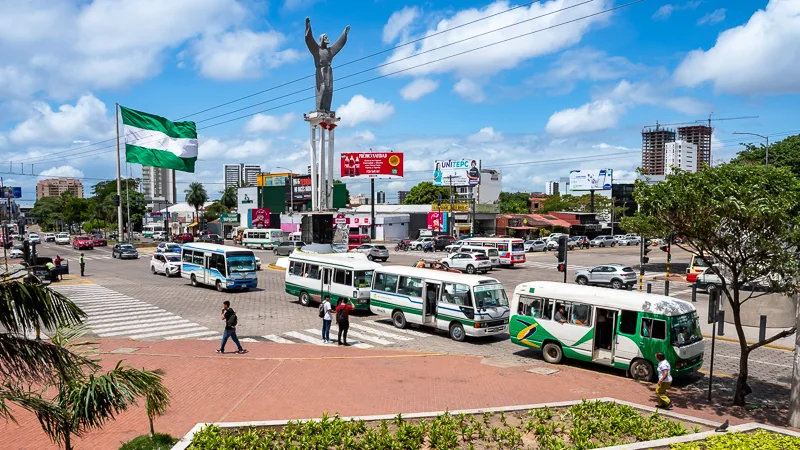
In Santa Cruz, the richer areas such as Barrio Equipetrol and around Aventura Mall felt very safe. It's an upscale area and some of the most affluent parts of the country. I was out walking on Av. San Martín after dark, and it still felt safe.
The old Historic Centro, however, was a different story. It is said to be safe, but the feeling I got was that while it's not unsafe in the sense that you should avoid it, it is an area where you need to be on your guard at all times of the day. If you stay on September 24 Square (Plaza Metropolitana 24 de Septiembre) and the adjacent quarters, it is safe. There's a great market for souvenirs that's not clearly marked on the maps on Libertad, north of the square. It's called Paseo Artesanal La Recova, and I found most of my souvenirs from Santa Cruz there.
The further you go from September 24 Square, the sketchier Centro becomes. It was also rather empty and lifeless. There's not that much to see either. You definitely need to go and visit September 24 Square and the Cathedral, but after you're done with that, there's not much else to do in Centro.
I walked to Parque El Arenal, a popular urban park within the Historic Centro. The park itself was fine; however, the area surrounding it is the type of area you would want to avoid.

Historic Centro of Santa Cruz
If you came to this page because you are worried about safety in Bolivia, I don't think you should be. Common sense will be everything you need.
Be aware of the possibility of political instability, which can disrupt your travel plans. Bolivia is a great country; I enjoyed it a lot, and chances are high that you won't face any problems at all. It's just one of those countries where you must be open to the possibility that your travel plans might be disrupted.
Street-level safety is not a major concern.


Read More From WorldThroughMyCamera.com